I used to build websites for clients, and one of the biggest changes I have seen is how people find businesses.
Google is not the only game in town anymore.
A lot of my own searching now happens while I am already working with an AI model. I will ask ChatGPT a question, compare options, look something up, or keep going without ever opening a traditional search page first.
That does not mean Google stopped mattering. It means the path to finding a business has changed.
Because the game changed, we changed too.
We started looking at what it means for a business to be found, understood and recommended by AI, and how we could make that useful for our clients.
That is where AEO comes in.
What is AEO?
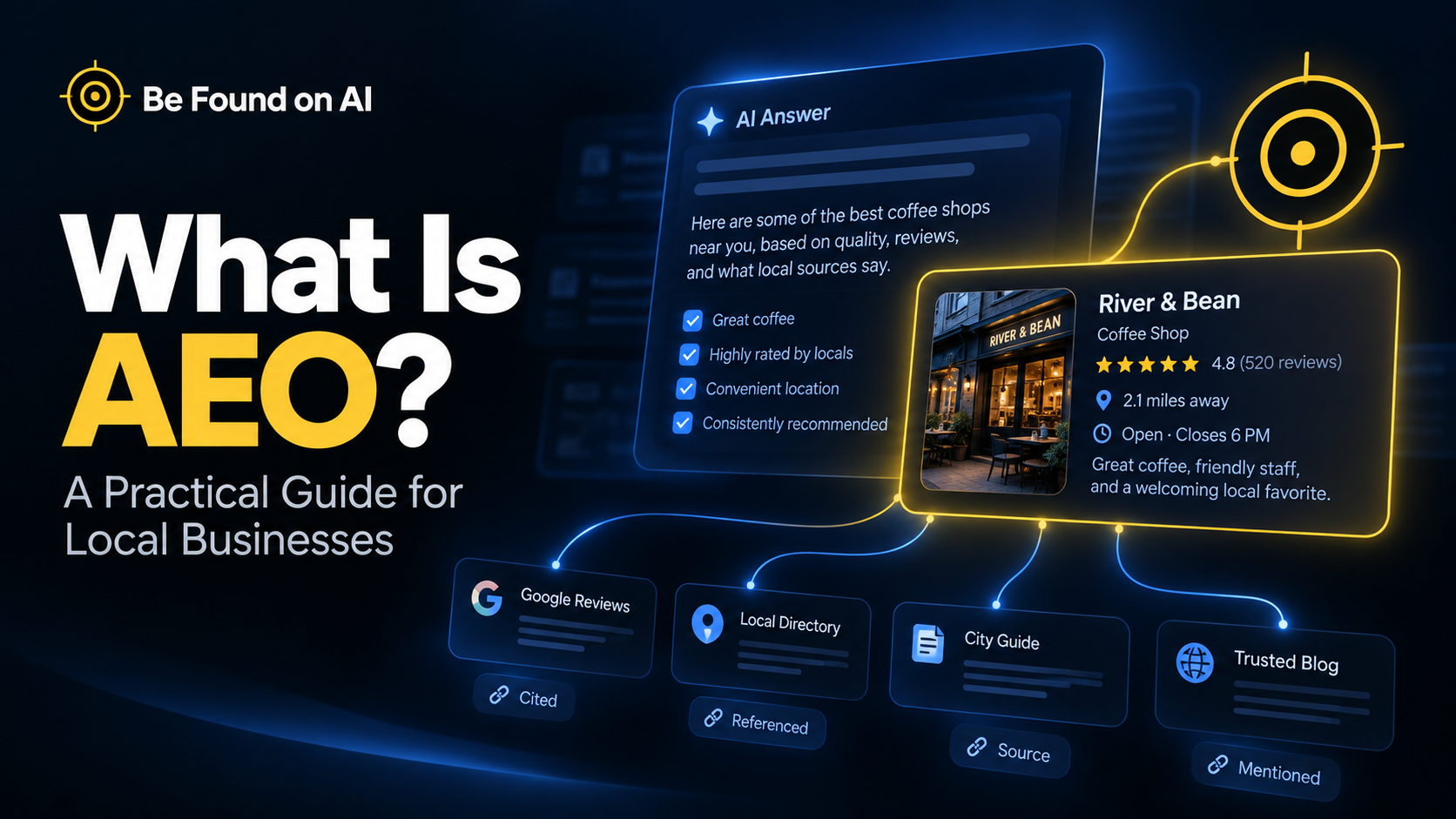
Answer Engine Optimization, or AEO, is the practice of making your business easier for AI-powered search and answer systems to find, understand, cite and recommend.
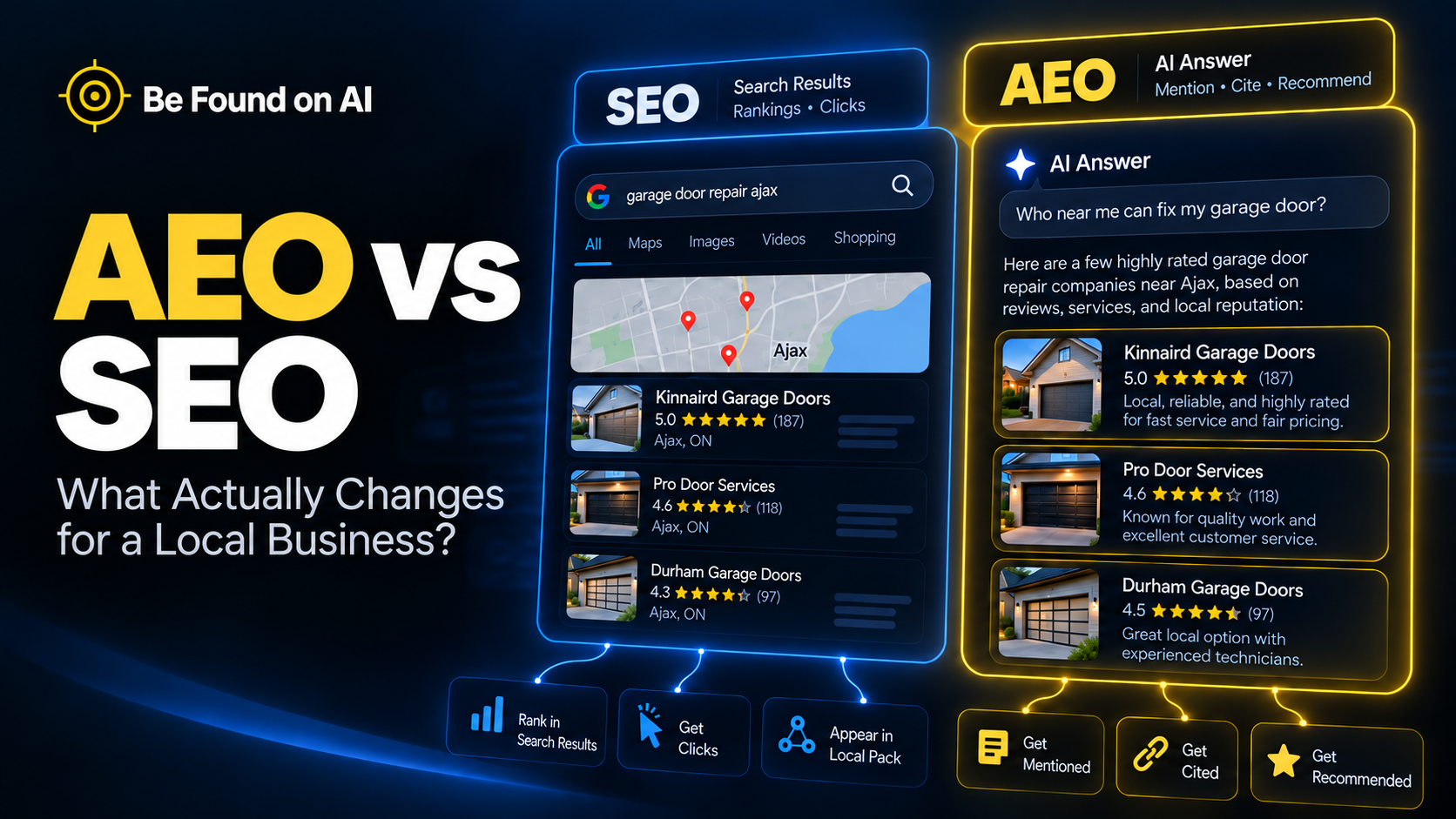
Traditional SEO helps search engines understand your website and decide when it should appear in search results.
AEO builds on that, but asks a slightly different question:
Can AI systems understand who you are, what you do, where you operate, and when your business is relevant enough to include in an answer?
For local businesses, that matters because people are now asking questions like:
- Who near me can fix my garage door?
- Who can come look at why my furnace is not working anymore?
- Who can I go to for my company’s taxes?
- What are my mechanic’s holiday hours?
- Who in Ajax can build an AI receptionist for our business?
Those do not sound like keyword searches. They sound like conversations. That is part of what has changed.
AEO does not replace SEO
AEO is not a replacement for SEO.
Good SEO still matters because AI systems rely on many of the same basic signals that help search engines understand a business: clear website content, useful pages, accurate information, and a site that can be crawled and understood.
The difference is what we are measuring.
SEO often asks: Can this page rank?
AEO also asks: Can AI understand the business well enough to mention it, describe it accurately, cite it, or recommend it?
There is a lot of overlap. A strong website helps both. But ranking well does not automatically mean an AI system understands your business correctly.
What does AI need to understand?
For a local business, the basics matter more than people think.
An AI system may need to work out:
- what your business is called
- what services you provide
- where you operate
- whether you are relevant to the question
- whether your information agrees across different sources
- whether there is enough reliable information to support an answer
Your website is part of that picture. So are business profiles, directories, reviews, local listings, and other public information.
That means you can have a polished website and still be difficult for AI to understand. If your homepage says one thing, your business profile says something slightly different, and an old directory still shows outdated information, the picture becomes less clear.
A person might work it out. A machine has to resolve it.
What does being found on AI actually mean?
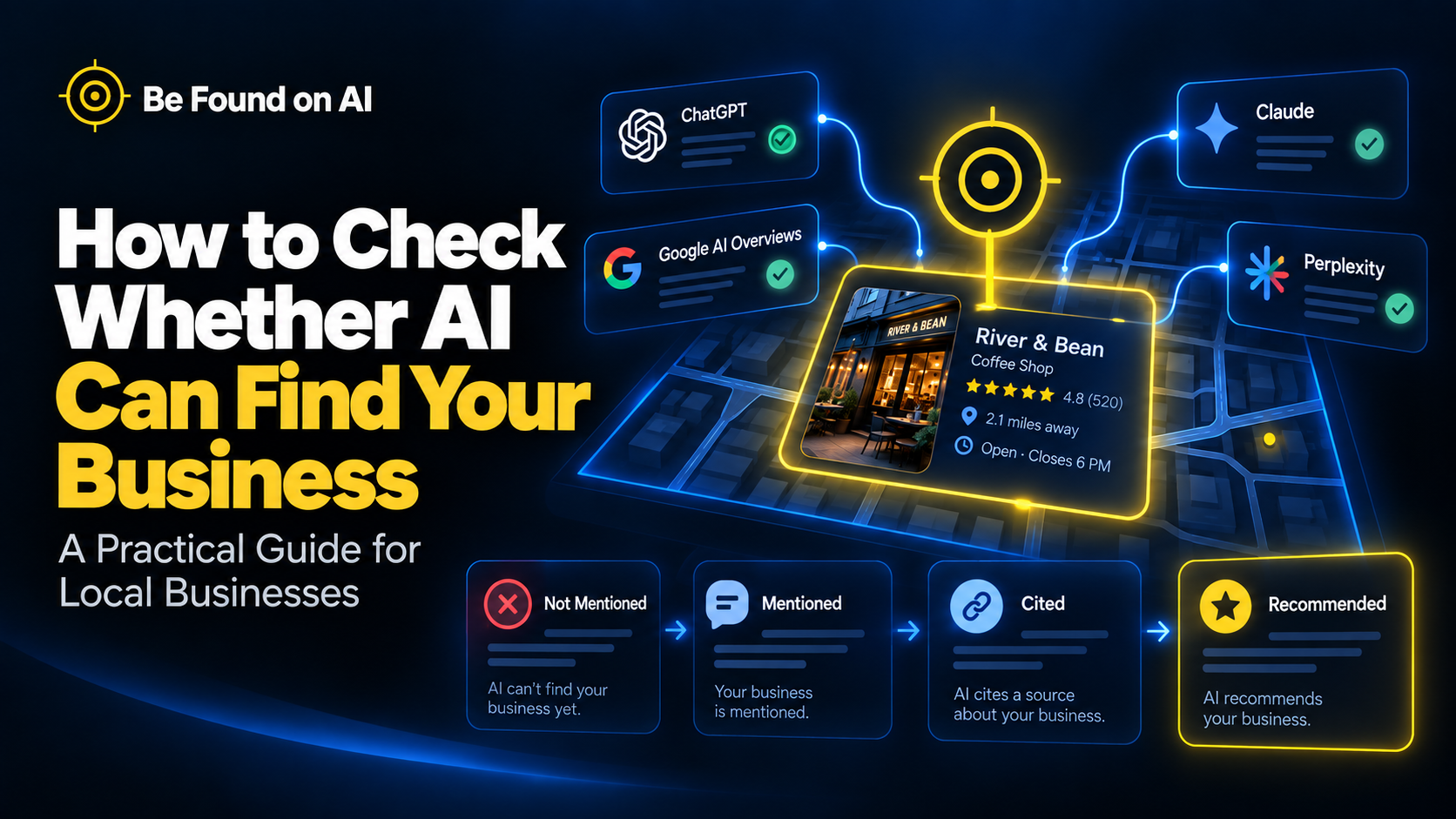
We do not treat AI visibility as a simple yes-or-no question. A business can appear in different ways.
At Be Found on AI, we use four practical visibility states.
Not Mentioned
Your business does not appear when relevant customer-style questions are asked. That does not automatically mean anything is broken. It means you are not being surfaced for the questions being tested.
Mentioned
Your business appears in an answer. That sounds positive, but the next question is: Is the information correct? AI can mention the right business while getting its services, location, hours, or description wrong.
Cited
A source connected to your business is used as evidence in the answer. That might be your website or another source associated with your business. Citations can help show what information the AI system is relying on.
Recommended
Your business is presented as a relevant option when someone asks who they should consider, contact, or hire.
This is the state most businesses naturally want. It is also the one nobody should promise they can guarantee. AI systems change. Their sources change. Their answers can change. The useful work is measuring what is happening now and improving what can reasonably be improved.
Why this matters
Traditional search gave businesses familiar things to measure. Rankings. Map results. Clicks. Traffic.
AI answers add another layer. A customer may get a summarized answer before visiting a website at all.
That means your business can be included, ignored, misunderstood, or replaced by a competitor before the customer ever reaches your site. That is worth paying attention to.
It does not mean every local business needs to rebuild its entire marketing strategy around AI. It simply means there is now another place where customers may encounter your business.
AEO is not about gaming AI
AEO will probably attract shortcuts, guarantees, and a lot of new terminology.
The more useful approach is simpler. Make your business information clear. Keep important facts consistent. Publish useful information. Make sure your site can be accessed and understood. Measure how AI systems currently describe your business. Then improve what the evidence tells you needs improvement.
That is a much more practical approach than trying to reverse-engineer every AI update.
Start by seeing what AI sees
You do not need to understand every technical detail of AEO before you begin.
The first question is much simpler:
Can AI systems find your business, understand it correctly, and include it when customers ask relevant questions?
That is what our AI Visibility Audit is designed to establish.
The audit looks at how your business appears across relevant AI platforms, whether the information is accurate, which competitors are being surfaced, what sources are influencing the answers, and where the most obvious visibility gaps are.
It gives you a baseline before you start changing anything.
Not Mentioned → Mentioned → Cited → Recommended
The point is not to chase a score. The point is to understand where you are now and what the evidence says should happen next.