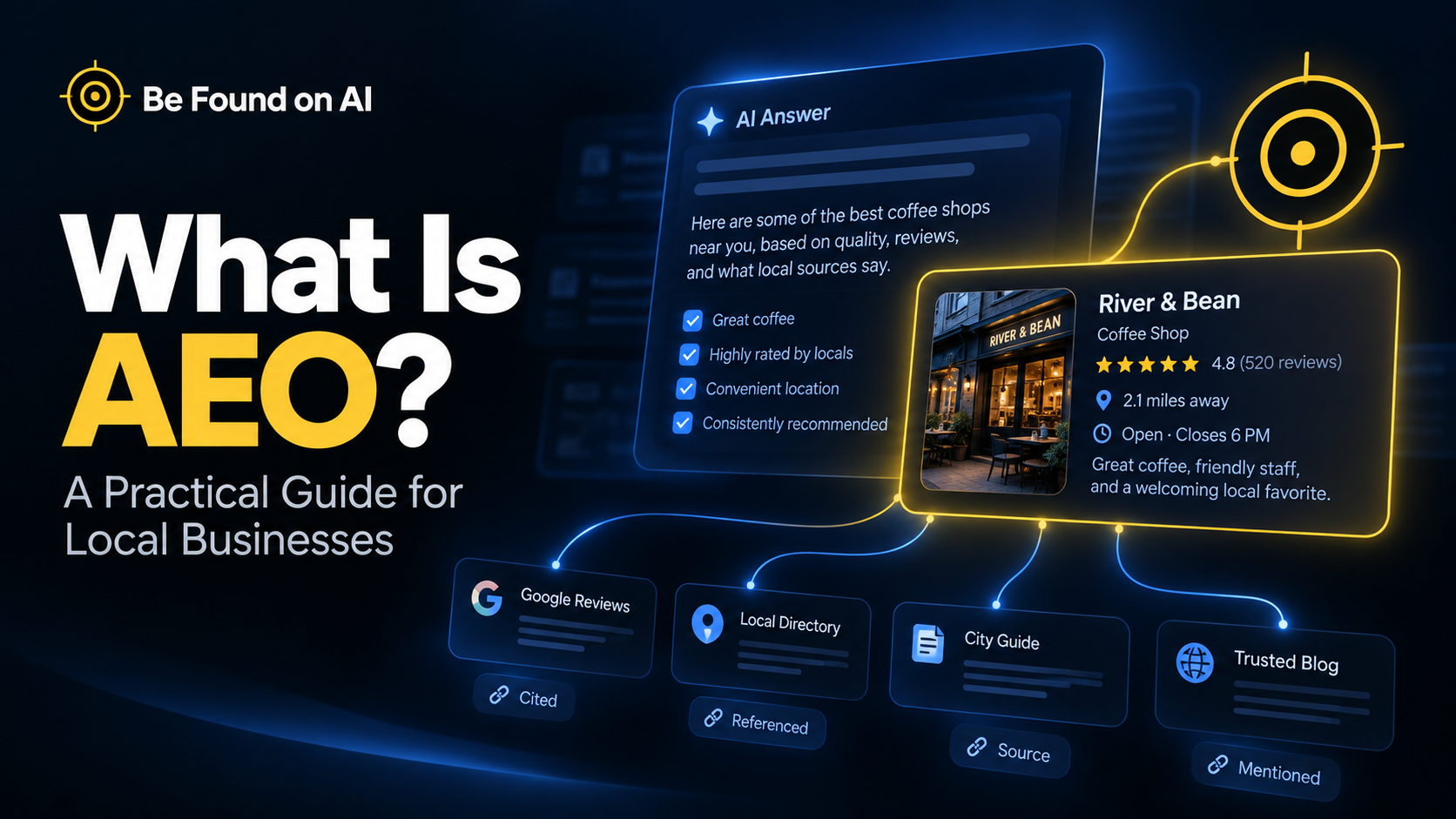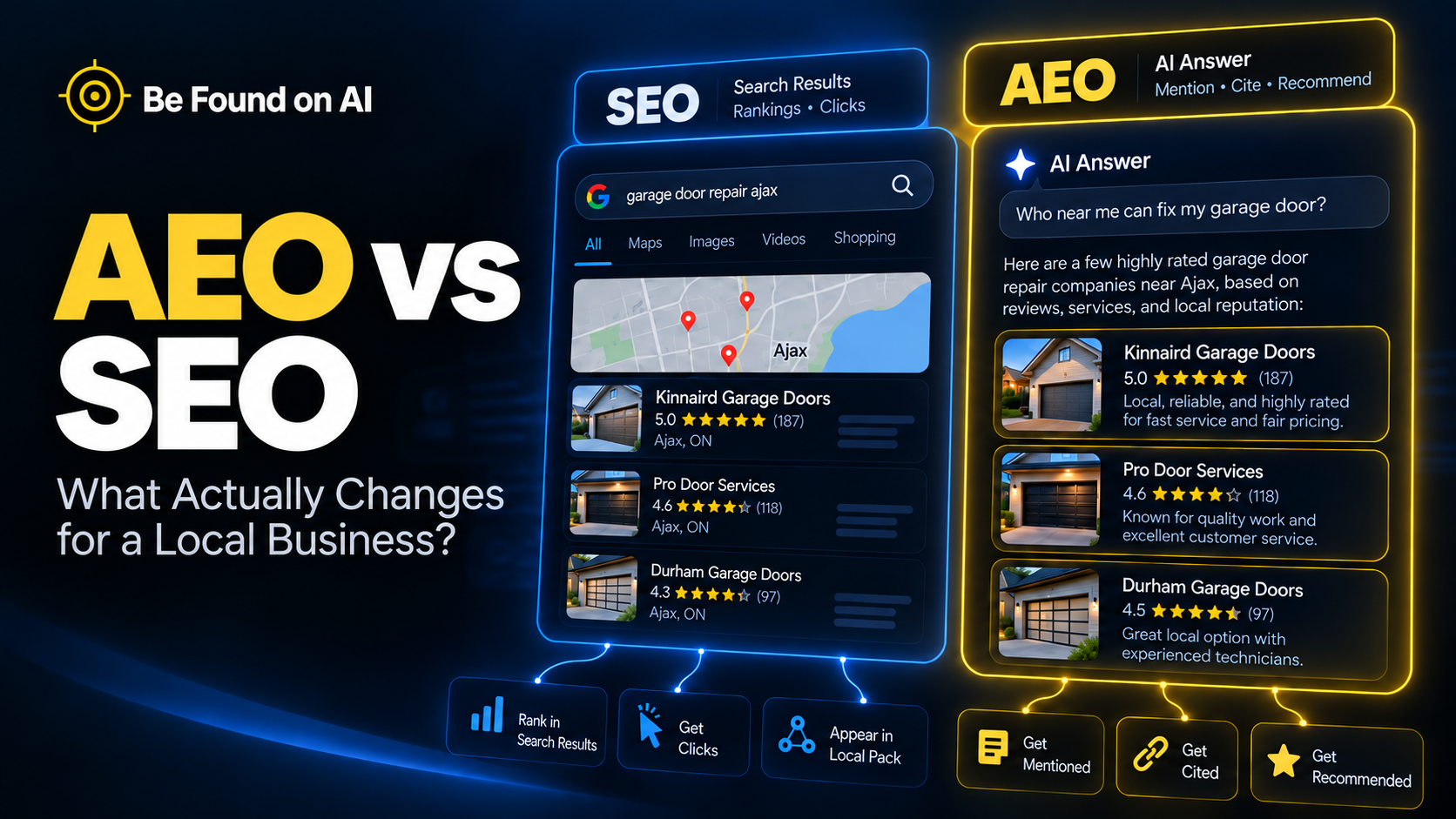
A lot of business owners have heard some version of this idea already: People are searching with AI now.
That part is true.
What usually comes next is less clear.
How do you actually tell whether AI can find your business?
Not in theory. Not based on a sales pitch. Not based on someone saying you need AEO.
Just: can AI find your business, understand it properly, and surface it when people ask relevant questions?
That is the real question.
Start with real questions
The first mistake people make is testing their business with questions no normal customer would ask.
For example: Tell me about ABC Heating and Cooling.
That can be useful sometimes, but it is not how most buying journeys begin.
A better approach is to test the kinds of questions an actual customer might ask.
- Who near me can fix my garage door?
- Who can come look at why my furnace is not working anymore?
- Who can I go to for my company’s taxes?
- What are my mechanic’s holiday hours?
- Who in Ajax can build an AI receptionist for our business?
These are much closer to how people actually use AI tools. They are conversational, specific, and often reveal more about visibility than a branded search does.
Check more than one platform
One of the biggest mistakes in this space is assuming one answer tells the whole story. It does not.
Different AI platforms may respond differently depending on the question, their data sources, and how they generate answers.
That means your business might be visible in one place and absent in another. Or accurate in one place and wrong in another.
The better question is not Did ChatGPT mention us once?
It is: What happens across the main AI platforms when relevant questions are asked?
That gives you a much more useful picture.
Look at how your business appears
If your business does appear, that is only the beginning. The next question is: how does it appear?
This is where businesses often discover the real problem.
A business might be mentioned, but described poorly. Cited, but through a weak or outdated source. Recommended, but only for the wrong type of query. Or missing entirely for the questions that matter most.
So you are not only checking for visibility. You are checking for quality of visibility.
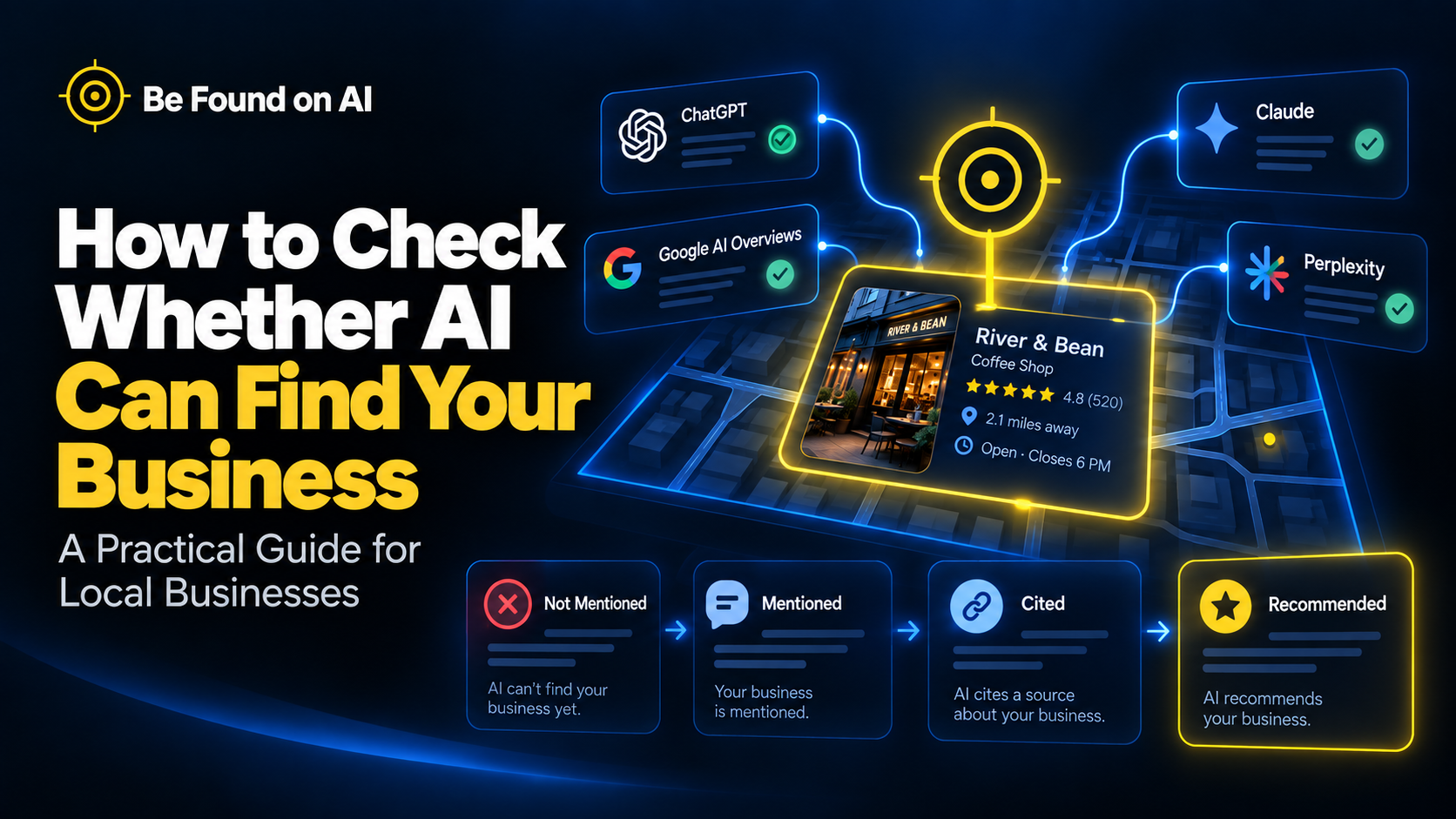
The four visibility states
At Be Found on AI, we use four simple visibility states to describe what is happening.
Not Mentioned
Your business does not appear for the question being asked.
Mentioned
Your business appears, but that does not automatically mean it is accurate or prominent.
Cited
The AI system uses your website or another source connected to your business as evidence.
Recommended
Your business is surfaced as a relevant option when someone asks who they should consider, contact, or hire.
Those four states give you a much more useful way to think about AI visibility than a vague yes-or-no answer, or some score out of 100.
Accuracy matters as much as visibility
A lot of business owners would probably be happy just to see their name mentioned. But mention alone is not enough.
If AI says the wrong thing about your business, that can be just as frustrating as being left out entirely.
For example, it may misunderstand your services, location, service area, business type, hours, or positioning.
That is why checking AI visibility is not just about being present. It is also about being understood correctly.
Competitors tell part of the story
Another useful clue is who appears instead of you.
If competitors are consistently being surfaced while your business is not, that tells you something important.
It may suggest they have clearer business information, stronger supporting sources, better entity consistency, more relevant content, stronger local signals, or simply better visibility for those question types.
That does not automatically tell you why. But it does show that something is happening.
Sources matter too
When an AI platform cites sources, that can be one of the most helpful parts of the process.
Those sources may include your own website, your Google Business Profile, directories, third-party sites, reviews, articles, and other public sources.
This matters because it gives clues about what information the system may be relying on. If the sources are weak, outdated, or inconsistent, that can influence the answer. If the sources are strong and aligned, the business is usually easier to understand.
The goal is not a one-time vanity check
This is where a lot of people go wrong.
They test one prompt once, get one answer, and treat it like a final verdict. That is not enough.
AI visibility is not a single moment. Platforms change. Sources change. Answers change.
You want to know where your business appears now, how it is being described, which competitors show up, what sources seem to influence the answers, and where the biggest visibility gaps are.
That is much more useful than a random screenshot.
So how do you check whether AI can find your business?
At the simplest level, you start by asking the right kinds of customer questions and looking carefully at what comes back.
But if you want a serious answer, the process needs to be more structured than a casual test.
That is exactly why our AI Visibility Audit exists.
It looks at how your business appears across relevant AI platforms, whether the information is accurate, which competitors are being surfaced, what sources are influencing the answers, and where the most obvious visibility gaps are.
If the main question is Can AI find our business, and what is actually happening? that is the right place to start.
If the next question becomes Why is this happening, and what should change? that is where the Complete AEO Audit goes deeper.